
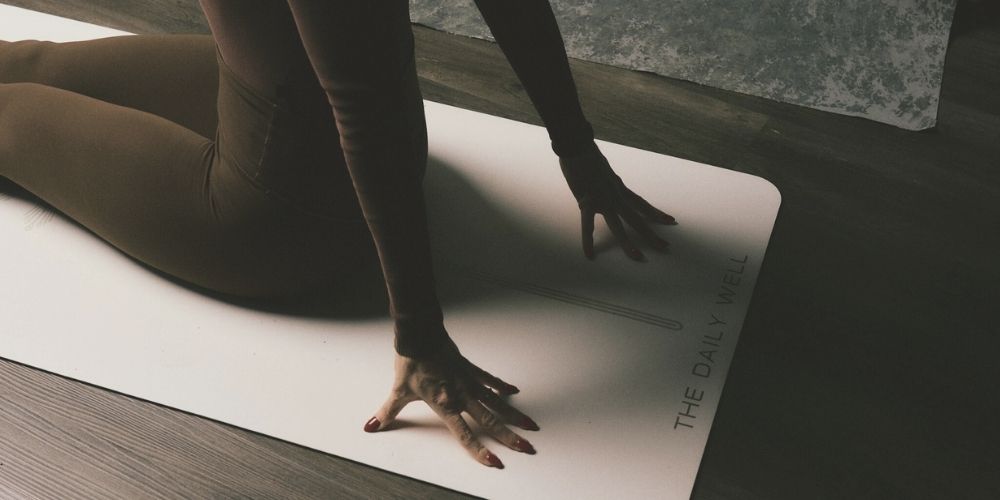

We live in a world that trains us to override fatigue, discomfort, the body’s quieter signals…until they aren’t quiet anymore. Somatic yoga is not about achieving a shape or getting flexible.
Online somatic yoga is a practice of return back into sensation, and your inner timing. It’s coming back into the part of you that knows when it’s safe to soften.
What is somatic yoga?
Neuroscientists and researchers are proving what yoga practitioners and movement educators have known for thousands of years and that’s that the human brain responds positively the subtle effects of slow intentional, mindful movement coupled with conscious breathing and meditation or prayer.
In somatics, we’re working in the deep subcortical parts of the brain where the brain talks to muscle.
Pain in the body often comes from something called sensory motor amnesia where the brain to muscle feedback circuit gets disrupted or switched off and then the muscles are chronically tight in the body.
There’s a lot of reasons why that happens, and it happens to all of us. The purpose of somatic movement is to reeducate the brain in the way that it orchestrates muscle movement. The feedback circuits are flipped on and there’s more efficient flow and accuracy information in this brain to muscle loop.
Working in the subcortical vaults of the brain, means we’re getting to the brain’s anterior insula which is a small island that has bridges of the communication to all the major parts of the brain.
It is the center of health and well-being.
This interior insula, our center of health and well-being, is what we’re making contact with in these practices.
Somatic yoga is slow, sensory-based movement designed to improve the communication between your brain and body.
Instead of pushing deeper into stretches, you move in small, mindful ways, often with pauses, so your nervous system can update old patterns. In somatic work, we’re not trying to force the body to change. We’re trying to help the body feel enough to reorganize.
Think of it like this. Stress and trauma don’t just live in the mind. They live in the musculature, the breath, the jaw, the shoulders, the belly, your fascia. They live in what you brace against without realizing you’re bracing.
Somatic yoga helps you notice what you’ve been carrying and gives your system a way to set it down.
Hot power yoga isn’t somatics (and that’s okay)
Hot yoga has its place. It can be cleansing, strong, and even joyful. But it’s not somatics. Somatic yoga is less about intensity and more about intimacy. It’s moving slowly enough to feel the truth of your body. In heated, high-output classes, it’s easy to slip into override and ignore the whisper, chase the stretch, push through the signal. Somatics is the opposite direction. It’s a practice of listening, pausing, and letting your nervous system lead so you’re not training endurance at the cost of awareness, but rebuilding awareness as the path to resilience.
Why somatic yoga matters for nervous system balance
When we’re under stress, the body shifts into survival mode. Survival mode shows up as changes in breathing patterns, tight muscles, attention narrowing into migraine or anger. This isn’t a personal failure, rather simple physiology doing its job.
Issues arise when survival mode becomes your baseline. When survival mode becomes your baseline, your body responds by thinking there is a constant threat. If you’re under constant threat, it does not matter if you get pregnant or digest your food or sleep. It doesn’t matter if your blood pressure, blood sugar, and heart rate are regulated. It does not matter if your mental health is sound. All these systems go dormant. All that matters is straight up survival from the lion chasing you. To escape the lion your adrenaline, norepinephrine, and cortisol must skyrocket. Heart rate needs to rise to pump more blood, and your muscles tense up in preparation to fight.
When the American Medical Association says that up to 85% of illness and health issues in the United States are rooted in untreated stress, this is why. We go to the doctor wanting to get fixed, but somehow, we never quite get there back to the health we had before.
Somatic yoga supports nervous system balance by training three things that stress tends to disrupt:
1) Interoception (your ability to feel what’s happening inside)
Somatic yoga asks: Can you feel your body from the inside?
Not “How does it look?” but “What do you notice?”
This matters because awareness is the beginning of regulation. When you can sense tension forming, you have a chance to respond before it hardens into a full-body pattern.
2) Autonomic flexibility (your ability to shift states)
Many people track this through heart rate variability (HRV) which is one (imperfect but useful) window into how flexible your autonomic nervous system is.
Yoga-based interventions have been associated with improvements in autonomic nervous system markers, including HRV, across multiple studies and reviews (with variability by population and program design). (pubmed.ncbi.nlm.nih.gov)
Practices that combine movement + breath + attention can help your body remember how to come down from “too much.”
3) The “permission” to slow down
At-home somatic yoga is powerful here: you’re in your own space, you don’t have to talk to anyone and chit chat, and you go at your own nervous system’s pace.
For many people, that alone is medicine.
Somatic yoga for stress healing (the kind you can feel in your shoulders)
Stress is not just a thought pattern. It’s a whole-body event.
And chronic stress has a cost: on sleep, mood, pain sensitivity, digestion, and inflammation. That’s why so many people feel like they’re “doing all the right things” mentally yet still feel tight, wired, heavy, or exhausted.
Yoga has been studied as a supportive practice for stress physiology and inflammation-related pathways. A review of yoga and inflammatory biomarkers suggests yoga may help reduce inflammation across a range of chronic conditions (though more high-quality research is always needed). (pubmed.ncbi.nlm.nih.gov)
Somatic yoga takes this a step closer to the ground by working directly with the body’s habitual bracing patterns incredibly gently, patiently, and without the “force” we find in vinyasa and power yoga.
Somatic yoga and trauma healing: why “gentle” is not small
Trauma healing is not about rehashing a story until it stops hurting. It’s often about helping the nervous system learn something new:
- I can feel sensation without getting flooded.
- I can have choice.
- I can come back to center.
Yoga has research support as a complementary approach for trauma-related symptoms. A 2024 meta-analysis found yoga interventions significantly improved self-reported PTSD symptoms compared with control conditions. (pmc.ncbi.nlm.nih.gov)
This doesn’t mean yoga replaces therapy. It means the body can and must be part of recovery, especially when the practice is trauma-informed. And what is trauma-informed? It’s choice-based, slow, and oriented toward safety.
Somatic yoga tends to be naturally trauma-sensitive because it emphasizes:
- smaller movements
- frequent pauses
- tracking “just enough” sensation
- building capacity over time
Somatic yoga DE-emphasizes pushing, performing, and “powering through.”
Somatic yoga and longevity: the long game is regulation
When people hear “longevity,” they often think of supplements, lab work, and optimization.
Those can have their place and are vital to a long life.
But longevity is also about something much more ordinary: how quickly you recover after life snags you.
A regulated nervous system supports healthy aging because it influences:
- sleep quality
- inflammation balance
- mobility and balance
- mood resilience
- social engagement and connection
And the quiet truth is that you don’t need heroic effort to train this. You just need repetition, consistency and a practice you’ll actually do.
That’s one reason online somatic yoga can be a longevity tool: it makes practice accessible enough to become real.
Your body is not a problem to solve
Somatic yoga is not about fixing yourself, but rather entering into conversation with your nervous system.
It’s about remembering you have an inner home.
A place you can return to again and again specially when life is loud.
And sometimes the most powerful thing you can do for your health, healing, and longevity is simply this:
Move slowly enough to feel.







Comments +