
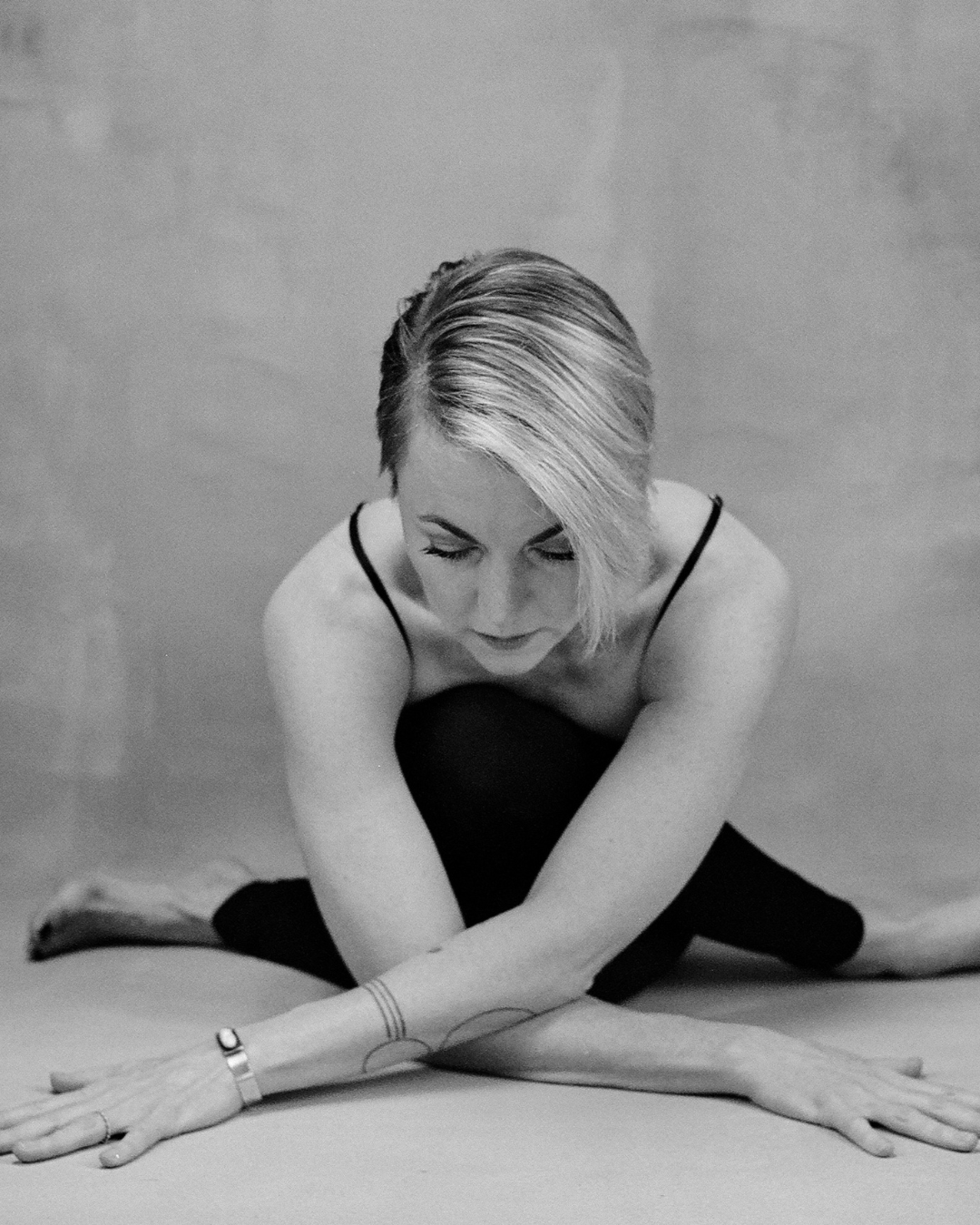

In a world that asks us to move faster, produce more, respond instantly, and stay endlessly available, Yin Yoga offers something radically different. It offers a structured practice of slowing down enough to listen.
Yin Yoga, as taught through the lens of Sarah Powers’ Insight Yoga, is not simply a slower form of yoga. It is a doorway into the body, the nervous system, the heart, and the mind. Her approach weaves together Yin and Yang yoga, Buddhist mindfulness, Taoist philosophy, Chinese medicine, and inner inquiry into a practice of deep listening.
Essentially, Yin teaches us how to meet ourselves beneath the noise.
Yin Yoga balances a very yang world
Most of modern life is yang in nature. It’s active, linear, productive, effortful, and goal-oriented. We move from task to task, often overriding the subtle signals of the body in order to keep going.
There is nothing wrong with yang energy. We need it as it helps us create, act, strengthen, lead, protect, and move forward. But when yang is the only mode we know, we can begin to live in a state of constant output. Sometimes this leads to living in hypervigilance.
In Sarah Powers’ Insight Yoga approach, yin and yang are complementary. Yin Yoga postures are more passive and held for longer periods, while yang practices are more dynamic and strengthening. Together, they support the whole person: body, energy, nervous system, and awareness.
Yin reminds us that healing does not always come from doing more. Sometimes it comes from softening enough to finally feel what has been waiting for our attention.
Yin Yoga works with the deeper tissues of the body
Unlike more active forms of yoga that primarily engage and strengthen the muscles, Yin Yoga works with the deeper connective tissues: fascia, ligaments, joints, and tendons. In Yin, we enter shapes slowly, find an appropriate edge, and stay long enough for the body to gradually open without force.
This is not stretching in the aggressive sense. It is more like listening through the tissues, hydrating the tissues, mobilizing the tissues.
The body begins to reveal where it has been holding tension, protection, grief, fatigue, or resistance. The stillness gives the nervous system time to register safety. The breath becomes less about control and more about relationship.
Sarah Powers’ Insight Yoga also draws from Chinese medicine and the meridian system, exploring how certain Yin Yoga poses may support the flow of energy, or qi, through the body. From this perspective, Yin Yoga is not only physical. It is energetic, emotional, and contemplative.
Sarah Powers’ three principles of Yin Yoga
Sarah Powers teaches three main principles in Yin postures. These principles are simple, but they completely change the way we relate to practice.
- The first principle is to come to your appropriate edge. This means entering the posture slowly and respectfully, without forcing the body or chasing the deepest version of the shape. The edge is not pain. It is the place where sensation is present enough to ask for your attention, but not so intense that the body has to brace against it. This is where Yin Yoga begins to teach discernment. We learn how to listen for the difference between intensity and aggression, between opening and overriding.
- The second principle is stillness. Once we find the shape, we allow the muscles to soften and let gravity do more of the work. This is where the pose becomes more than physical. In stillness, we begin to see our habits. We notice the urge to fidget, adjust, escape, plan, or mentally leave the room. Instead of making those impulses wrong, Yin gives us a place to watch them with compassion.
- The third principle is time. Yin postures are held longer than more active yoga poses because the deeper tissues of the body respond slowly. Fascia, joints, ligaments, and the energetic body cannot be rushed. Time is part of the medicine. As we stay, the breath settles, the nervous system begins to trust the pause, and the posture becomes a container for patience, surrender, and presence.
Together, these three principles remind us that Yin Yoga is not about how far we can go. It is about how honestly we can listen. The shape is simply the doorway. The real practice is learning to stay connected to ourselves while sensation, emotion, thought, and resistance move through.
Try these concepts in action in our introduction to yin yoga class.
Yin Yoga gives us access to the inner life
One of the most profound benefits of Yin Yoga is that it creates the conditions for insight.
When we are moving quickly, we often skim the surface of ourselves. We may know we feel off, tired, tight, or anxious, but we rarely pause long enough to listen more deeply.
In a Yin posture, there is nowhere to rush. The pose becomes a small meditation. Sensation, thought, emotion, patterns…they all arise.
We may notice the impulse to escape discomfort, or how quickly the mind wants to fix, label, or understand the experience. We may notice how hard it is to let support hold us. We may notice that our bodies have been asking for tenderness for a very long time.
This is why Yin Yoga is not passive in the way people often imagine. It can look quiet from the outside, but inside, an incredibly rich process is unfolding.
Yin Yoga supports the nervous system
Many of us live with bodies that are constantly scanning for what needs to be done next. Even when we are technically resting, our inner system may still be running.
Yin Yoga gives the body a different message.
Through longer-held, supported shapes, slower breathing, and mindful attention, the practice can help shift us out of constant activation and into a state of greater regulation. The body begins to understand that it is allowed to pause, allowed to soften, that is has permission to just be here.
This is one of the reasons Yin Yoga can feel so emotionally potent. When the body finally feels safe enough to soften, what has been held down may begin to rise. That is not a problem. That is part of the unwinding.
Yin Yoga teaches us how to be with discomfort
So much of our suffering comes from believing discomfort means something has gone wrong.
Yin Yoga gently challenges that belief.
In practice, we learn the difference between pain and sensation, between wise adjustment and habitual avoidance, between softening and forcing. We learn that discomfort can be met with breath, patience, curiosity, and care.
This is a skill that goes far beyond the mat.
Life will bring discomfort. There will be seasons of uncertainty, grief, transition, fatigue, and change. Yin Yoga gives us a place to practice staying connected to ourselves in the middle of what is uncomfortable, without numbing, bracing, or abandoning ourselves.
The deeper purpose of Yin Yoga
Yin Yoga reconnects us to the quieter voice within. Not the loud voice of fear, urgency, or the one that says we have to earn rest, but the deeper voice. The one that knows.
Through stillness, sensation, breath, and mindful awareness, we begin to rebuild trust with the body. We learn its language. We start to recognize when something feels aligned, when something feels forced, when we need movement, when we need rest, and when we are pushing past our truth.
This is why Yin Yoga is a practice of intimacy. It brings us closer to ourselves.
The essence of the practice is simple: come into a shape, find your appropriate edge, become still, and stay for time. But simple does not mean easy. Stillness can be confronting. Slowness can reveal how addicted we are to distraction. Support can show us where we have been over-efforting. Silence can make visible the inner narratives we usually outrun.
And yet, this is where the medicine lives.
Yin Yoga does not ask us to become more impressive. It asks us to become more honest, more available, more receptive, and more compassionate toward the full truth of our human experience.
The why of Yin Yoga
We practice Yin Yoga because the body needs more than strength. It also needs space.
We practice because the nervous system needs more than stimulation. It also needs safety.
We practice because the heart needs more than protection. It also needs tenderness.
We practice because the mind needs more than information. It also needs silence.
And we practice because beneath the roles, responsibilities, striving, and speed, there is a quieter truth waiting to be felt.
Yin Yoga gives us a way back to that truth.
It reminds us that we do not always have to push our way into transformation. Sometimes transformation happens when we become still enough to listen, patient enough to soften, and brave enough to stay.



Comments +